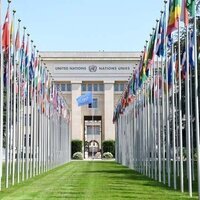



Initiatives Pour Le Dsarmement Nuclaire (IDN) will be presented this plan in New York at the side event on " Reducing the risks of nuclear war: a multi-faceted approach" to be held on Monday27 April at 3:00 pm at the UN in Conference Room A.
According to many prominent figures, including former UN Secretary-GeneralBan Ki-moonand his successorAntnio Guterres, the group of former leaders known asThe Elders, and former US Secretary of DefenceWilliam Perry,the risk of nuclear war has never been higher since the Cold War. For decades, nuclear deterrence has been presented as a tool to prevent war, based on the fear of devastating retaliation in the event of aggression. However, recent developments in doctrine (such as Donald Trump'sNuclear Posture Reviewin February 2018 and hisNational Security Strategyof December 2025, or Russia'snuclear doctrineof November 2024) show thattechnological choices and uncertainties are contributing to breaking the taboo of non-use.
These developments aredangerously lowering the threshold for the useof the approximately12,320 existing nuclear weaponsandleading the world towards catastrophe: the use of cruise missiles or even hypersonic missiles that can evade defences, miniaturisation of nuclear warheads, scenarios of escalation to nuclear weapons in the event of a conventional, chemical, biological or even cyber attack, increasing risks of accidental or terrorist use and computer hacking, dependence on artificial intelligence, anti-satellite threats, etc.
These risks areexacerbatedby:
- Regional crises involving nuclear powers(India-China-Pakistan, the Middle East, the Korean Peninsula), and explicitthreats by Russiato use nuclear weapons following its aggression against Ukraine;
- Thesystematic dismantling of the control architecturethat had hitherto ensured stability both in the US-Russian context (ABM Treatyon anti-missile defences,INF Treatyon intermediate-range missiles,New STARTTreaty on deployed strategic offensive systems) and in the multilateral framework (failure of theComprehensive Nuclear Test Ban Treatyto enter into force, US withdrawal from theOpen Skies Treatyand theIran Nuclear Deal(JCPOA), Russia's withdrawal from theTreaty on Conventional Forcesin Europe);
- Thefrantic arms racein which all the nuclear powers are engaged, launching costly long-term programmes to modernise their arsenals and introducing new weapons described asexoticbut above all more usable.
TheInitiatives for Nuclear Disarmament(IDN) association, founded in 2014 by Paul Quils, former French Minister of Defence, like many states and personalities around the world, is convinced thatthe only effective way to prevent nuclear war is not to accumulate, modernise and make nuclear weapons more usable, but to eliminate them. That is why it has presented or supported several measures that would, in the short term,reduce the risk of nuclear war, in the medium term,prevent the proliferation of nuclear weapons, and in the long term,eliminate them through a multilateral, progressive and controlled process. It is updating its Action Plan for the 11th Review Conference of the Non-Proliferation Treaty (NPT) in 2026. It believes that France can play a leading role in this process and thus regain a space for initiative and influence.
IN THE SHORT TERMURGENTLY REDUCE THE RISK OF NUCLEAR WEAPONS BEING USED
- Lower the alert level of nuclear forces to the lowest possible level
Of the approximately3,912strategic and non-strategic nuclear weapons deployed by the United States and Russia, about half are on high alert, allowing for launch within minutes of detecting an enemy launch. It is this status that
risks triggeringan accidental, mistaken or unauthorised nuclear war. In particular, weapons must be separated from their delivery systems in order to give decision-makers time to intervene and prevent such a catastrophe. High-level experts have shown in severalstudiesthat this measure, far from weakening defence capabilities, facilitates decision-making in times of crisis.
- Adopt a policy of no-first-use of nuclear weapons by renouncing the possibility of taking the initiative to use nuclear weapons
All nuclear powers, with the exception of China and India (with regard to all countries) and China and Russia (bilaterally), include in their doctrine scenarios for the first use of nuclear weapons against non-nuclear attacks by other nuclear powers or by non-nuclear-weapon states (exceptions tonegative security assurances). Onlya policy of no-first use of nuclear weapons will significantly reduce the risk of nuclear weapons being used. Indeed, only a nuclear attack is capable of threatening a country's vital interests. All other scenarios can be effectively deterred by conventional weapons or other forms of defence.The Conference on Disarmament, where all nuclear powers are represented, is the ideal forum for negotiating such an agreementon the basis ofChina's proposalto the other nuclear powers bound by the NPT.
- Strengthen the system of transparency on nuclear weapons
Following the 2010 NPT Review Conference, the nuclear-weapon states bound by the NPT agreed in 2013 on amodel national reporton measures taken in favour of nuclear disarmament, as well as on their doctrines and arsenals. These reports are generally published at each Review Conference, but it must be noted that they are of uneven quality and contribute little totransparency. Such transparency would, however, reassure non-nuclear-weapon states that their ownnon-proliferation commitments are balanced by credible nuclear disarmament efforts. The 2026 NPT Review Conference should provide an opportunity to strengthen such a transparency system, taking into account the concerns expressed and proposals made at the2022 Review Conference.
- Strengthen the management of cyber and AI risks associated with nuclear systems
Managing cyber and artificial intelligence risks in nuclear early warning as well as command, control and communication (NC3) systems requires ensuring thathumans retain exclusive controlover all decisions regarding their use, the prohibition of cyber operations aimed at disrupting or deceiving adversarial nuclear systems. Nuclear powers and allied states should negotiate a set of legally or politically binding standards and commitments aimed at:
- Reaffirming the principle ofexclusive human controlover any decision to use nuclear weapons, explicitly prohibiting delegation to AI systems, including in the form of launch on algorithmic recommendation;
- Prohibiting theintegration of generative or non-robust AIinto the critical functions of early warning and C3 systems until there are verifiable guarantees regarding their reliability, their resilience to adversarial attacks and the traceability of their decisions;
- Establishingmutual cyber red lines: a ban on any cyber operation aimed at disrupting, deceiving or blinding adversarial nuclear systems (radars, early warning satellites, command networks, sensors) or their critical supply chains, drawing on the work of the IAEA, UNIDIR and existing recommendations regarding the IT security of nuclear facilities;
- Establishing apermanent mechanism for notification, emergency consultation and common cyber hygieneamong nuclear powers (tests, incidents, major intrusions, vulnerabilities discovered in software used by several states), in order to limit the risks of misunderstanding or misattribution in the event of a cyberattack or AI failure;
- Launching, under the auspices of the UN (General Assembly, First Committee, or Conference on Disarmament), a process to draft anInternational Code of Conduct on Military AI with Nuclear Implications, covering AI deployed in conventional systems capable of having a decapitation effect or neutralising a second strike, and thus fuelling nuclear escalation dynamics;
- Supporting, at both scientific and diplomatic levels, independent and transparentresearch into the behaviour of AI in simulated nuclear crisis scenarios, in order to inform evidence-based regulation, as already illustrated by studies showing a worrying tendency for current models to opt for escalation in the majority of simulations.
France, drawing on its expertise in the cybersecurity of critical infrastructure and its standing in international debates on AI regulation, could play a leading role in bringing these commitments into the debate within the NPT (2026 Review Conference) and in forums dealing with both cyberspace and disarmament, by explicitly linking the reduction of nuclear risks to the management of emerging technologies.
- Remove American and Russian tactical nuclear weapons from Europe
NATO must announce thewithdrawal of all American tactical nuclear weapons(B61 gravity bombs) deployed in five member countries (Belgium, Germany, Italy, the Netherlands, Turkey) in exchange for thetotal withdrawal of Russian tactical nuclear weaponsfrom Europe (including Belarus). The approximately 100 American weapons, known as tactical weapons, are intended for use with the participation of the host countries' military forces on European soil and in the context of a nuclear escalation between the United States and Russia. Moscow's approximately 2,000 weapons are not deployed but stored at a distance from their delivery systems. Far from ensuring NATO's security, the deployment of American weapons increases therisk of European countries becoming targets for nuclear attacks. Theirneutralisation, initially, and then their elimination, will facilitate the negotiation of further reductions in American and Russian strategic nuclear arsenals.
IN THE MEDIUM TERM
STRENGTHENING THE NON-PROLIFERATION OF NUCLEAR WEAPONS
- Work towards the entry into force of the Comprehensive Test Ban Treaty (CTBT)
The entry into force of thistreaty, adopted in 1996, is still dependent on ratification by nine countries, including six nuclear-weapon states (China, North Korea, Egypt, the United States, India, Iran, Israel, Pakistan, Russia), even though its provisional application has demonstrated the ability of its verification regime to detect North Korean tests.Joint ratification by the United States, Russia and China, followed by an international campaign,would have a knock-on effect on other statesand further strengthen the norm of testing bans, an essential element of the non-proliferation regime. RecentUS statementsabout a possible resumption of explosive testing andWashington's accusationsof low-yield Chinese testing demonstrate the importance and urgency of negotiations towards a common interpretation and verified compliance with the CTBT.
- Negotiate without delay a treaty banning the production of fissile material for nuclear weapons (FMCT)
Although most nuclear powers have declared unilateral moratoriums on the production of fissile material (highly enriched uranium and plutonium) for weapons purposes given the size of theirstockpiles,there is no legally binding international treatyon the issue. A new norm prohibiting such production would be an effective means of preventing the development of new nuclear programmes. If Pakistan continues to block the start of negotiations at the Conference on Disarmament, citing the imbalance it claims to suffer in relation to Indian stocks, the framework of the UN General Assembly should allow for such negotiations. In order to facilitate this,a simple ban on all future production(French draft treaty)must be accompanied bya commitment by the nuclear powers not to draw on their existing stocksto produce new weapons.
- Negotiate without delay and without preliminary conditions the denuclearisation of the Korean Peninsula in a multilateral framework allowing for mutual benefits
As a priority, the freezing of North Korea's nuclear and ballistic programme in exchange for the freezing of US-South Korean military exercises should make it possible to resume multilateral negotiations (Six-Party Talks), the only
realistic framework for achieving effective denuclearisation of the Korean Peninsula and the lifting of sanctions against Pyongyang. Achieving this goal obviously requires the conclusion of a peace agreement between the United States and North Korea and the establishment of a nuclear-free zone in the region (known as3+3: on one side, the two Koreas and Japan, and on the other, the nuclear powers acting as guarantors: the United States, Russia and China).
- Reaffirm the commitment of nuclear-weapon states to make further progress in reducing the role of nuclear weapons in security policies
Stemming from the obligations contained inArticle VI of the NPTto negotiate in good faith for nuclear disarmament in the context of general and complete disarmament, this commitment, included in theFinal Document of the 2010 NPT Review Conference, aims tomake the security of states less dependent on nuclear weapons and thus make them less attractive to states tempted by proliferation. At a minimum, the nuclear powers should deepen their discussion, initiated within theP5 group, of their nuclear doctrines in order toreduce misunderstandings or misinterpretationsthat could fuel a dangerous arms race.
- Work towards a Zone free of Nuclear Weapons and other Weapons of Mass Destruction in the Middle East
This project has been on the agenda of the UN and the NPT since 1991. Despite several attempts in1995and2010, the negotiation process for establishing such a zone remains blocked by the dilemma ofdisarmament first(Arab countries, Iran) andpeace first(Israel, United States). Theannual conferencelaunched by the UN General Assembly in November 2019 should allow for acompromise combining confidence- and security-building measures with disarmament measures, but it continues to be boycotted by Israel and the United States. TheJoint Comprehensive Plan of Action(JCPOA) on Iran's nuclear programme, which came into force in 2015, was respected until 2018, but the crisis caused by the US withdrawal and Iranian retaliation, as well as US and Israeli military actions in 2025, removed the only multilateral and verifiable thus effective means of preventing Iran from acquiring nuclear weapons. Despite its demise, it should be considered amodel in terms of non-proliferation and verification, particularly by excluding the production of highly enriched uranium and plutonium in conflict regions such as the Middle East.
IN THE LONG TERMELIMINATE NUCLEAR WEAPONS GRADUALLY AND UNDER CONTROL
- Announce new negotiated reductions in nuclear arsenals
As holders of 90 percent of the world's nuclear weapons,the United States and Russia have the primary responsibility to negotiate, as a matter of priority after the expiry of the New START Treaty, substantial and verifiable reductionsin their arsenals, including all categories (deployed and non-deployed strategic, non-strategic) as well as missile defence and space components. Such a lowering of the ceilings will make it easier to involve other nuclear powers in the negotiations and in the joint study of reliable verification systems. Thefreezing of current modernisation programmesincluding the launch of new types of weapons (Americancruise missileswith low-yield warheads, Russianhypersonic missilesor nuclearsubmarine drones) should be the starting point for these new negotiations, as should the inclusion of intermediate-range missiles covered by the former INF Treaty. TheGeneva Conference on Disarmament, whose members include the nine nuclear-weapon states and whose agenda includes nuclear disarmament,provides an ideal framework for such negotiations.
- Proceed with further unilateral reductions in nuclear arsenals
Several nuclear powers, including France, have already madeunilateral reductions in their nuclear weapons stockpiles. The United Kingdom has eliminated its airborne component, retaining only its submarine component. France has done the same with its land-based component and could continue with the gradual elimination of its
airborne component, which is considered unnecessary, vulnerable and costly. Similarly, having modernised its submarine missiles, it can further reduce their number and the number of warheads they carry without any adverse effects.These interim measures would give concrete expression to the commitment enshrined in the NPT, Article VI of which calls for the progressive and continuous disarmament of nuclear powers. The aim is therefore to reverse the current trend towards quantitative growth and qualitative modernisation of nuclear arsenals, including by intermediate powers (China, North Korea, France, India, Pakistan and the United Kingdom).
- Join the mechanism provided for by the Treaty on the Prohibition of Nuclear Weapons (TPNW)
Thistreaty, adopted by 122 states at the UN, entered into force on 22 January 2021. Although its negotiation was boycotted by the nuclear powers and their allies, it fills an important legal gap: after biological and chemical weapons,it establishes the norm of prohibiting nuclear weapons, the last category of weapons of mass destruction to be bannedbecause they cannot be used in compliance with international humanitarian law due to its principles of distinction, proportionality, and precaution.
The Treaty provides that states possessing such weapons have the choice of adhering to this treaty: eithereliminate their weapons and join it, orbecome parties to the treaty and announceto the other states parties a verifiable disarmament plan(if necessary, negotiated with the other nuclear powers). Since the TPNW came into force, it is no longer legally possible for nuclear powers to claim that the possession, threat of use or use of nuclear weapons is legitimised by the NPT or the UN Charter. At this stage, around 100 countries have signed the TIAN, demonstrating the strength of the norm prohibiting nuclear weapons. Admittedly, no nuclear powers or countries under a nuclear umbrella have signed it yet. However,several of them have attended meetings of states partiesas observers, a sign of a willingness to engage in dialogue that should be expanded. Furthermore, even if non-states parties claim not to be bound by the treaty,it codifies norms, particularly international humanitarian law, that are already applicable to all states. Finally,non-states parties may already be affectedby the states parties' compliance with their obligation not to cooperate in any scientific, financial or economic activity related to nuclear weapons. It would therefore be in the interest of the nuclear powers and their allies to join this process in order to reconcile their security requirements with the widely shared goal of a world free from the threat of nuclear weapons.
Pressenza New York